
Searching the Cherokee County Court Docket
Figure out which Cherokee County court holds the case before anything else. Circuit Court takes felonies, domestic relations matters, and the larger civil claims. District Court keeps misdemeanors, traffic cases, preliminary felony steps, District Civil cases, and small claims. Centre and Cedar Bluff run municipal courts. They handle many city ordinance, misdemeanor, and traffic matters. Probate keeps its own separate records. Get this first step right. No single free countywide name search reaches every office that holds a docket.
For most state trial-court case information, the Cherokee County Circuit Clerk directs the public to paid Just One Look. Free electronic viewing still works at the courthouse terminal. A sound docket search runs in a short sequence:
- Identify the court, division, and issuing agency.
- Use the full case or citation number when possible.
- Select Cherokee County in the proper state search.
- Read all later entries for resets or dispositions.
- Confirm unclear settings with the correct clerk.
Just One Look for Cherokee Cases
Just One Look, also called AlacourtAccess, is Alabama's paid on-demand service for Circuit and District Court information. Pick Cherokee as the county. The best key is an exact case number. A name search can pull in unrelated people, so weigh the court, filing year, case style, division, and other non-sensitive details before trusting a match.
Do not confuse Just One Look with AlaFile. AlaFile transmits filings and service for authorized users. The general public does not use it for lookup. A paid result is not always the whole official file, either. It may stop at the case-action summary, while some document images need another account, a fee, or a request to the Cherokee County Circuit Clerk.
The AlacourtAccess entry point opens the statewide gateway that Cherokee County docket searches run through.
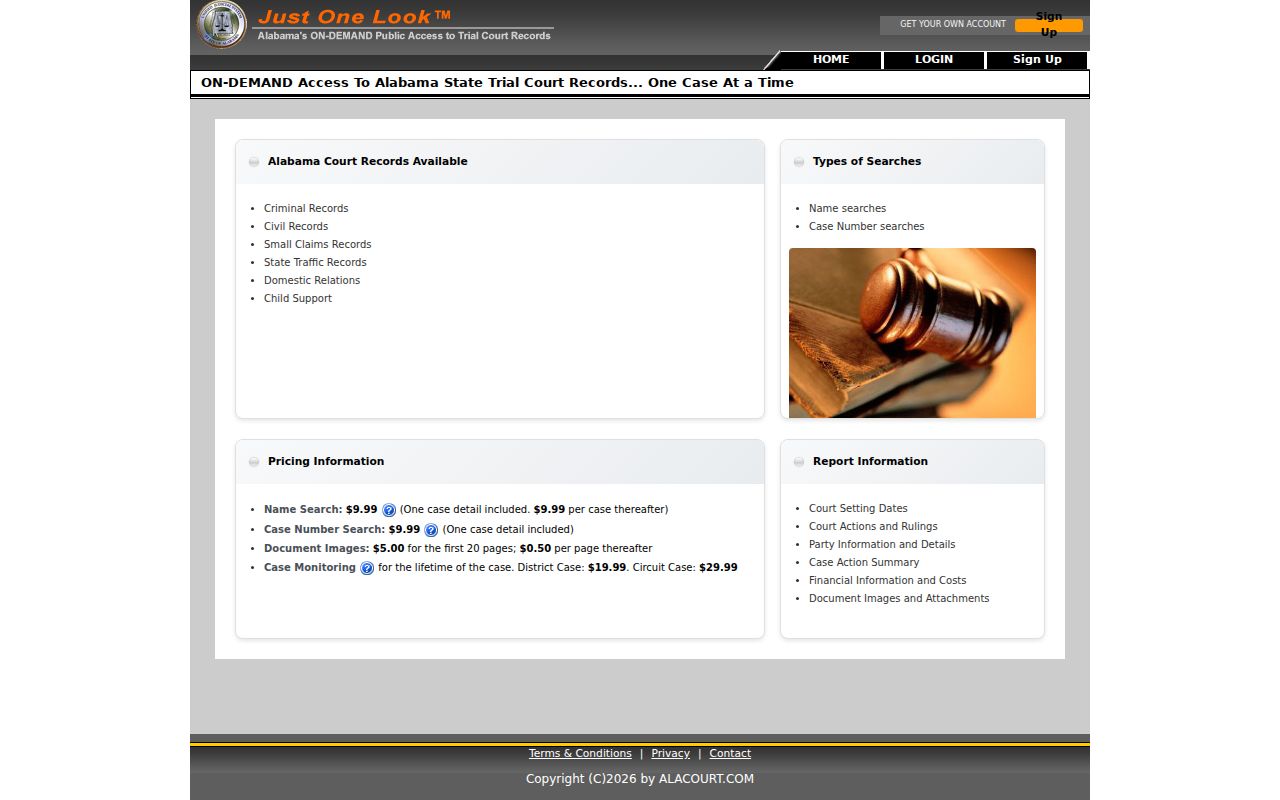
That gateway is the remote route. The clerk's courthouse terminal is the no-charge inspection route.
Inside a Cherokee County Court Docket
Picture a Cherokee County court docket as a dated log. It records everything that happens in a case. One line might list the division and the case number. It may also carry the filing date and the case style. Others name the judge, the parties, and the lawyers. Still more list the type of case, settings, and current status. Criminal matters run from the charge and bond through plea, motions, orders, trial, and sentence. Civil matters trace the complaint, service, and answer. From there they move into motions, judgment, and collection steps that come later. Which fields are public depends on the case and your access level.
Read it in order, from the first event to the newest. Be careful, though. A motion entry means someone filed a request. Nothing more. It is not a ruling that the judge granted anything. In the same way, a hearing line is a setting, not a result. Before you rely on an older date, check the newest valid notice or order.
| Case header | Court, division, case number, filing date, style, judge, type, and status. |
|---|---|
| Event list | Filings, notices, hearings, orders, resets, and disposition in date order. |
| Participants | Party roles and counsel, subject to privacy limits. |
| Financials | Assessments or balances when the public view includes them. |
Cherokee Docket Versus Filed Document
A docket line and the paper it points to are different things. In Cherokee County, an entry may say a complaint, indictment, motion, or order was filed. The text of that document sits behind the line. Write down the event date and title first. Then ask for that specific item. A narrow request helps the clerk pull the right page set without delay.
Certification adds a third layer. A certified copy carries the clerk's authentication, which formal use demands. A printout from a screen does not qualify on its own. Transcripts take a separate route through the court reporter. If you need a judgment, request that judgment by name rather than the entire file. Skip that only if you truly need every item in it.
Key point: Search the docket first, identify the exact entry, then order the underlying document or certified copy.
Courts That Keep Dockets in Cherokee County
Cherokee County sits in Alabama's Ninth Judicial Circuit. The Circuit Clerk in Centre maintains both Circuit and District files. Some Ninth Circuit judges keep chambers in Fort Payne. Municipal clerks and the Probate Office hold their own records separately. Ask the wrong office and a perfectly valid case simply will not appear.
| Court or office | Docket covers | Where to search |
|---|---|---|
| Circuit Court | Felonies, domestic relations, and major civil cases | Just One Look or Circuit Clerk |
| District Court | Misdemeanors, traffic, preliminary felony matters, small claims, and District Civil | Just One Look or Circuit Clerk |
| Municipal Courts | City ordinances and qualifying city misdemeanor or traffic matters | Issuing municipal court |
| Probate Court | Estates and other statutory probate matters | Cherokee County Probate Office |
Appeals and transfers split one matter into two records. A small-claims appeal moves up to Circuit Court. A felony may start in District Court and then continue under a Circuit Court number. When the Cherokee County docket lists both numbers, search each one.
Cherokee County Civil Docket Lanes
Money decides where a civil case lands in Cherokee County. Small Claims handles disputes up to $6,000. District Civil picks up at $6,000.01 and runs through $20,000. That lane also covers unlawful detainer filings. Anything above that ceiling belongs to Circuit Civil. Domestic Relations sits inside the Circuit division as well. So the dollar amount tells you which Cherokee County docket should hold the case. It also warns you that a docket search limited to one civil division can miss the filing entirely.
The clerk's fee tables cover filing and service costs, not copies. Local small-claims codes SM1, SM2, and SM3 mark dollar tiers here. Other abbreviations deserve a check against the live system before you rely on them. The full Cherokee County civil docket search walks through service, motions, judgments, and post-judgment entries in more detail.
How to Find Court Dates and Settings
Cherokee County puts out two annual PDF calendars. One covers Circuit Court and one covers District Court. Match the PDF to your case type first. These are planning documents, not a live party-name docket. So once you spot a likely session, open the case-action summary. Look for anything later: continuance, reset, cancellation, plea, settlement, or disposition. Compare the newest docket notice against anything the court mailed or sent you.
Traffic dates carry a local twist. The county warns that the date printed on a ticket is an appearance date. It is not automatically the trial date. Show up then to request trial if you contest the citation. Domestic cases set their dates on a separate track. When the PDF and a case notice disagree, call the clerk with the case number rather than guessing. The Alabama Judicial System source offers the official statewide court detail.
The state's court structure explains why Cherokee County keeps separate Circuit and District calendar tracks for its court docket.
Cherokee County Calendar Conflicts
Three Cherokee County sources can carry a date. These are an annual calendar PDF, a docket setting, and a case-specific notice. Each does a different job. The PDF lays out planned court sessions for the year. The docket logs settings and every later change. A notice tells the parties about one particular event. A later signed order or valid notice can move a case even while the static calendar still shows the general session.
Read past the first setting entry. Match the entry date to the event date, and keep whichever notice is newest. For a conflict you cannot resolve, contact Suite 102 at (256) 927-3637. The clerk can confirm the current recorded setting but cannot give legal advice. Weather and holiday closures are not on any county feed either. So call the court directly.
Public Access to Court Dockets
Alabama's Rules of Court-Record Privacy and Confidentiality took effect on January 1, 2025. Rule 401 says electronic Circuit and District dockets and court records are open for free public viewing at the clerk's office. This applies during regular hours. The same rule allows remote subscriber access and copy charges. Free viewing does not make every copy or remote search free.
Cherokee County access has limits. Juvenile cases, adoptions, certain mental-health files, and personal identifiers may stay off the screen. The same goes for sealed filings and anything restricted by law or court order. The county also notes that an arrest warrant stays non-public until served. And a missing remote result proves nothing about a case being sealed, dismissed, or even existing.
Access rules:
Alabama Rules of Court-Record Privacy and Confidentiality set the public-viewing, copy, remote-access, redaction, and sealing framework.
Alabama Rules of Civil Procedure 77 and 79 address clerks and the records they keep.
Alabama Code sections 36-12-40 and 36-12-41 address inspection and certified copies of public writings.
Cherokee County Rule 401 Access
Remote convenience carries a charge. But viewing the electronic docket at the Cherokee County courthouse is free. That distinction drives most docket access decisions here. Ask to inspect the electronic docket at the clerk's office. Then pay only for the pages you truly need. Most nonparty copy requests may carry fees, and mailed requests add postage. The Cherokee County Probate Office page belongs to a different office from the Circuit Clerk.
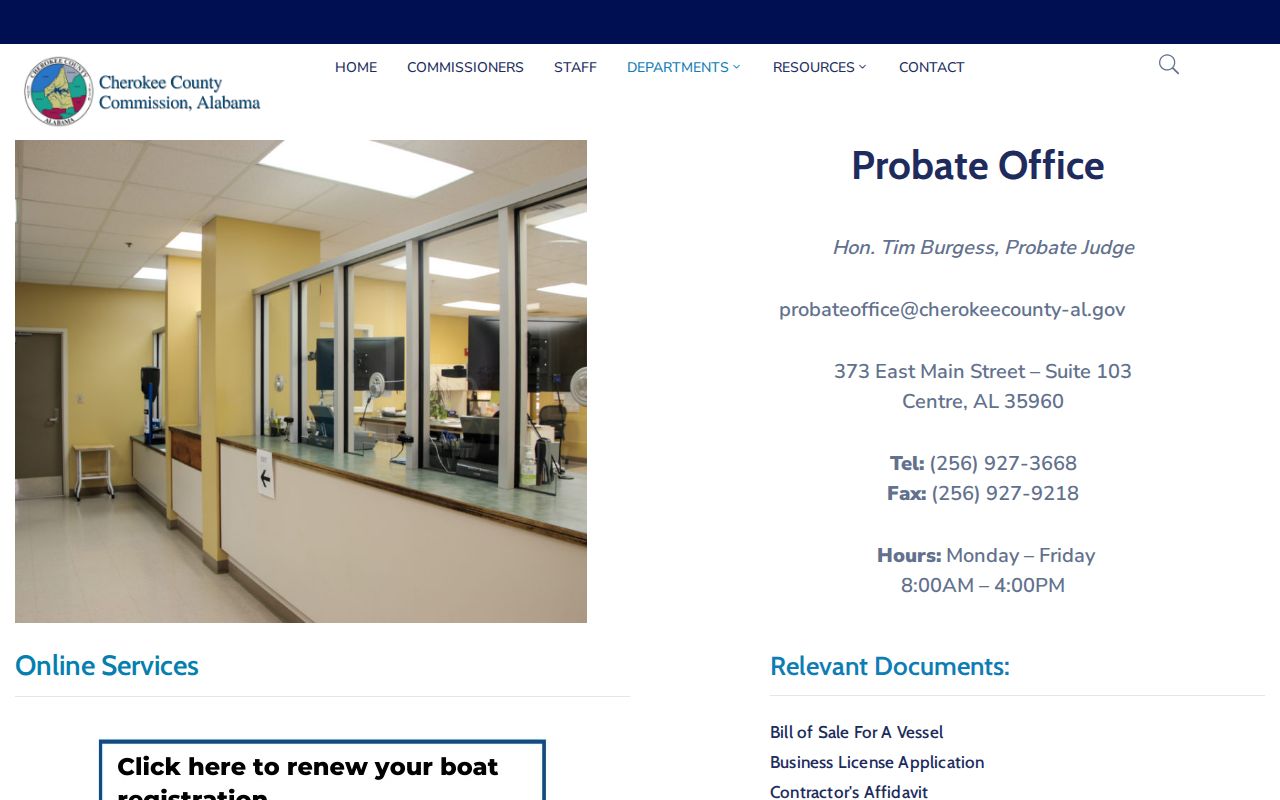
Route probate matters there instead of forcing them through the Circuit and District Court search chain.
Docket Records at the Clerk's Office
The Cherokee County Circuit Clerk serves as record keeper and business manager for Circuit and District Court. The office runs civil, criminal, domestic, child support, traffic, juvenile, and warrant divisions. Records are electronically imaged. Staff also issue notices, manage jury work, prepare subpoenas, and collect court funds.
You can reach the office in person, by phone, by written request, or by mail. The official Request for Records form wants specific information. List case numbers when known, an approximate filing year, certification preference, and contact details. Expect to allow two weeks, include a $5 deposit, and wait for a balance quote. The search charge applies even when no record turns up.
Cherokee County Circuit Clerk
373 E. Main St., Suite 102
Centre, AL 35960
(256) 927-3637
Monday through Friday, 8:00 a.m. to 4:00 p.m., closed noon to 1:00 p.m.
Cherokee County Docket Copy Costs
Copy charges are separate from court filing fees. The local research fees run $10 for a computerized search, $20 for paper, and $25 for archived or microfilm work. Pages one through twenty cost $5, then $0.50 per page after that. Certification adds $5 per item. Confirm the current total and payment method before sending any money.
| Record service | Verified amount |
|---|---|
| In-office electronic viewing | $0 under Rule 401(A) |
| Computer, paper, or archive search | $10, $20, or $25 |
| Copies | $5 for pages 1 to 20, then $0.50 each |
| Certification | $5 each |
For mailed requests, pay after the quote with a cashier's check or money order. Personal checks are not accepted in the published record-request process. Include a self-addressed stamped envelope, and ask about older paper, microfilm, or off-site retrieval before you set a deadline.
Cherokee County Court Dockets by City
Where a case started can change the docket route. Centre and Cedar Bluff keep municipal matters inside their own city courts. Leesburg police traffic goes to Cherokee District Court, per the county magistrate instructions. Sand Rock calls for a county check. The town spans Cherokee and DeKalb context. Gaylesville searches usually begin with the issuing agency and the county rule.
Centre Docket Search
Separate municipal and county courthouse records by issuing court.
Cedar Bluff Docket Search
Start town ordinance and municipal traffic matters with the town court.
Leesburg Docket Search
Leesburg police traffic routes to Cherokee District Court.
Sand Rock Docket Search
Verify the county before selecting a clerk or calendar.
Gaylesville Docket Search
Use the citation and issuing agency to choose the record keeper.
Historic Cherokee County Docket Research
Older Cherokee County records may live as paper files, indexes, bound volumes, or microfilm. A gap in Just One Look often just means the record predates the remote range. Give the clerk an approximate year, the division, and party names. Add the case number if you have it. Ask where the material sits. It may be on site, off site, on microfilm, or transferred. The Alabama Department of Archives and History research service is the next official channel. Use it once records have been transferred.

Ask the Circuit Clerk first. Not digitized does not mean destroyed, and no Cherokee County courthouse record loss is on record.
Map and Directions to the Cherokee County Courthouse
Circuit and District Court files are kept at the Cherokee County Courthouse, 373 East Main Street, Suite 102, in Centre, the county seat. The Circuit Clerk's counter there is the free viewing point for the electronic docket, while the District Judge is also listed at this address; Circuit judges of the two-county Ninth Circuit keep their primary chambers at the DeKalb County Courthouse in Fort Payne, so a judge's office may sit outside Cherokee even though the case file stays in Centre.
Cherokee County Courthouse
373 E. Main St., Suite 102
Centre, AL 35960
(256) 927-3637
Monday through Friday, 8:00 a.m. to 4:00 p.m., closed noon to 1:00 p.m.
No official page publishes a public-terminal count, parking rule, or entry-screening list for this courthouse, so expect customary security screening and call (256) 927-3637 ahead about devices, large files, or an accessibility need.